There are essentially two ways of looking at grammar. There is the prescriptive approach which tells people which forms of language to use based on the standard and the descriptive approach which explains naturally occurring grammatical phenomena. For this blog I will be looking at the prescriptivist approach to language grammar.
My title for this blog may seem a bit esoteric, but this is a phenomenon that almost everyone is familiar with. Indeed, I'm sure that your grade school teachers did their part to teach you what is standard and what is non-standard English Many people are very sensitive, and many are not so sensitive, to the correct and incorrect ways of speaking English. This is less of a case of right and wrong, and should more accurately be labeled as standard and non-standard distinction. Standard being the form of English which we deem "right" or "correct". These linguistic puritans make sure that speakers of the English language, or at least they themselves, are using English the proper way. It should come as no surprise to us then, that a large number of the population are like this, me included, because of the correction we have received through our lives from teachers, parents, etc.
Linguistic puritanism is an interesting movement. It is good because it means that since we are all at least familiar with standard English we can understand almost all other speakers of English with no difficulty. The problematic part, however, is what it seeks to accomplish. A whole-hearted linguistic puritan would desire strict adherence to the standard wherein there may be no room for linguistic change at all. This is a problem because languages are either changing or dead. This sort of extremism is not encountered much, however, so English dying any time soon is of little concern.
When we begin to think of English forms as standard and non-standard we also encounter another little interesting tidbit. Should we be so concerned with what is "right" English if the changes are just necessary and logical changes in the progression of English? Why do differences in English seem to offend us on a moral level where we can classify "good" forms of English and "bad" form? For instance I know many people who are offended or somewhat annoyed at least by the wide sweeping use of "seen" as the past tense of "saw" as in "I seen it". There should be nothing "wrong" about this use of 'seen' as it is a simple matter of dialectal variation and standard English not some moral code that we must adhere to. There is nothing "more correct" about the standard form of English or the rules laid down in grammar textbooks. (It is also interesting to note that some of those rules were simply made up by the grammarians themselves.)
So if you have made it this far, pause for a minute to look at your own approach to language grammar. Do you take the puritan approach and side with the prescritivist or do you tend to not worry about maintaining "pure" English with the descriptivist?
Are you somewhat morally offended when people use forms of English improperly, and do you have any insights as to why this may occur?
Saturday, August 2, 2008

Friday, May 9, 2008
Learn to speak archaically, with flare!
I have noticed that many people have the tendency to use archaic verb and pronoun forms, as well as syntax, especially when referring to the King James Bible or the writings of Shakespeare. Both of these great giants of literature date form the Early Modern E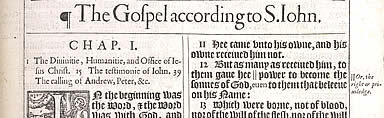 nglish period (1500-1800) and in both they use a form of English called (big surprise) Early Modern English. People like using Early Modern English, but I have also noticed that it tends to be abused slightly, so in this informative blog I want talk about how to speak Early Modern English. (This sounds like one of those phrasebooks people get when they are going to another country on holiday. Something that may be titled, "Early Modern English With Ease!" or "The Quick and Easy Way to Learn Early Modern English, Today!") Okay so, I admit that a phrasebook on Early Modern English might not be the next bestseller, but here are some tidbits just for interest sake.
On pronouns
So if you were going to address one person you would use the 'thou' forms and more than one person the 'you' forms. However, beyond this there was also a formal/informal distinction, similar to the one in French and Spanish. If you were referring to one person but wanted to address them formally you would use the 'you' forms, like the king for instance by saying "your majesty", though the king is only one person. The 'thou' forms then only became used as the informal singular way of addressing someone. So the 'thou' forms would be used with a close friend or social inferior. It is also important to note that the formal/informal distinction developed after the singular/plural distinction. I know some of you may be wondering at this point why the King James Translation of the Bible does not use this formal/informal distinction, such as referring to God as 'thou'. This is a bit complicated, but it mostly has to do with the conservative way in which it was translated, and its strong reliance on (by that I mean almost copying) earlier translations.
Here are some examples of usage and just for fun I have thrown in some other archaic vocabulary:
- Whither thou walkest?
- I walke yonder, whilst they walketh thither.
- Doest thou walk by thineself? ('walk' does not need the ending here because it is attached to 'do')
- Verily, as ye walketh together, I walke alone.
Okay, I think you get the idea.
And there you have it! Speaking Early Modern English never seemed so easy! Alright, so it probably doesn't seem any simpler at this point and it may in fact seem more confusing, but I am just trying to do my part to encourage properly spoken archaisms.
 nglish period (1500-1800) and in both they use a form of English called (big surprise) Early Modern English. People like using Early Modern English, but I have also noticed that it tends to be abused slightly, so in this informative blog I want talk about how to speak Early Modern English. (This sounds like one of those phrasebooks people get when they are going to another country on holiday. Something that may be titled, "Early Modern English With Ease!" or "The Quick and Easy Way to Learn Early Modern English, Today!") Okay so, I admit that a phrasebook on Early Modern English might not be the next bestseller, but here are some tidbits just for interest sake.
On pronouns
| | SG | PL |
| Subject | Thou | Ye/ you |
| Object | Thee | You |
| Possessive | Thy/ thine | Your (s) |
So if you were going to address one person you would use the 'thou' forms and more than one person the 'you' forms. However, beyond this there was also a formal/informal distinction, similar to the one in French and Spanish. If you were referring to one person but wanted to address them formally you would use the 'you' forms, like the king for instance by saying "your majesty", though the king is only one person. The 'thou' forms then only became used as the informal singular way of addressing someone. So the 'thou' forms would be used with a close friend or social inferior. It is also important to note that the formal/informal distinction developed after the singular/plural distinction. I know some of you may be wondering at this point why the King James Translation of the Bible does not use this formal/informal distinction, such as referring to God as 'thou'. This is a bit complicated, but it mostly has to do with the conservative way in which it was translated, and its strong reliance on (by that I mean almost copying) earlier translations.
On verbs
The verb must agree in number and person with the subject.
I will use the verb "walk" as an example:
| 1SG: I walke | 1PL: We walketh |
| 2SG: thou walkest | 2PL: Ye walketh |
| 3SG: He/She/it walketh | 3PL: They walketh |
Here are some examples of usage and just for fun I have thrown in some other archaic vocabulary:
- Whither thou walkest?
- I walke yonder, whilst they walketh thither.
- Doest thou walk by thineself? ('walk' does not need the ending here because it is attached to 'do')
- Verily, as ye walketh together, I walke alone.
Okay, I think you get the idea.
And there you have it! Speaking Early Modern English never seemed so easy! Alright, so it probably doesn't seem any simpler at this point and it may in fact seem more confusing, but I am just trying to do my part to encourage properly spoken archaisms.
Wednesday, May 7, 2008
What? Is this a new post I "C"?
 an you believe it? A new post indeed. Today I would like to address the status of the letter "c". As a linguist-in-training I reserve the right to be completely obsessed with language and its orthographic representations, the alphabet in the case of English, so today I will ramble on about the letter that resides as the third letter in our alphabet but yet is one of the most unstable and unreliable letters in the alphabet. While most of the letters in the alphabet represent one instance of sound in all places, take the reliable "p" for instance, "c" may represent 5 different sounds:
1. It is pronounced as a "k" sound. The hard "c", if you will, like in the word 'cake' and 'cookie' and Cookie Monster eating cake.
2. "c" becomes "s" before the vowels e, i, y. This is the so-called "soft c"
3. "c" may form an alliance with "h" as in the word 'cheese'.
4. "c" also has the tendency to become a "sh" before "e" or "i" such as in 'ocean' or in some borrowings from French such as 'champagne'.
5. "c" may also be silent, such as in 'muscle'.
Many of the problems that arise in the unreliability of "c" come from its unstable origins. In early Latin the letter "c" consistently was pronounced with the "k"-like pronunciation. However, this clarity was short lived. By about 400 B.C, a sound change had diffused through Latin where the hard "c" sound became what we know as the "ch" sound before high front vowels, e, i, and y, a process called affrication. Thus giving us 2 varieties of "c", one like "k" and one like "ch". In some languages, such as French, this process of weakening continued until "c" was pronounced as a soft "c" or "s" sound. English imported all of this variety of "c" usage, giving "c" such a diverse pronunciation.
The problem of "c"'s ambiguity has not escaped linguists throughout the history of English. Many people have sought to resolve the problem that "c" presents in the English language, some giving it the harsh fate of banishment from English. During the Early M
 odern English period (1500-1800 A.D.) John Hart wanted to reform the spelling of English. The image above is an example of John Hart's proposed spelling reform for English from his book An Orthographie published 1569. Notice how 'k' replaces 'c' in the word "come" spelled by Hart as "kum". Hart wanted "c" to remain only to represent the sound "ch", and for the other symbols "k" and "s" to take over the places where "c" is used to represent these sounds. Not at all a bad idea in my estimation. However, like any spelling reformation the costs of such a project would be almost insurmountable, not to mention that the whole process would be extremely confusing. So, instead of jumping one the spelling reform bandwagon I think I will remain content to leave the status of "c" as is. As long as I get to complain about how stupid it is.
Tuesday, November 27, 2007
An exerpt from my life
Back by popular demand is the following story which I composed while I was at Capernwray in England. It chronicles a small token of my life in a fashion that you will hopefully find enjoyable.
It happens that sometimes in the pursuit of fitness there are mishaps. Some of these have to do with the mutilation of the human body, others the destruction of valuable specially bought, most of the time, expensive equipment. The particular mishap that befell my exercise experience had to do with a defective bottle of shampoo.
I recently decided that I would, in light of the freshman 15 affliction, pursue an exercise regimen. There are a number of sweat producing activities that can be participated in at Capernwray. The most popular option seems to be jogging. According the Heathers Concise Dictionary of the English Language, often abbreviated as HCDEL, jogging is defined as, “the exhausting punishment of the human body in order to achieve physical fitness.” As a strong supporter of the HCDEL, I decided against this popular choice. I began searching for other ways to work off a few pounds that didn’t cause me to hate the sport after three days. What I found was quite exciting. I decided that I would take up swimming laps in the pool in the mornings before breakfast. Not having swum since the 7th grade when I was an active member of the swim club, made an interesting show for the first while, but eventually I took to it like a fish to water.
Yes all was well, I was getting exercise, I was enjoying it and I was not gaining weight, as rapidly that is. However one dark day, I came across something very disconcerting. My backpack which I toted to and from the pool was slightly wet, a little gooey and smelled mildly like the fruity goodness of Herbal Essences. Yes, you guessed it, my backpack had been attacked, by a improperly shut bottle of shampoo, that is. This was a proper catastrophe. Now my beautiful backpack, the instrument of my traveling experience had the encountered first hand just what the essence of the Herbals is.
I, in my typical band aid fix style, spot cleaned my backpack and kept on using it for my swimming purposes. This all had to come to an end, however, when I needed the backpack for a weekend trip to Edinburgh, Scotland. I was forced to clean it. I could not be a simple throw in the washer situation because this particular backpack has a metal frame. This forced me to scrub it in the sink and like all good shampoos my whole backpack took to frothing and lathering something extraordinary. The lathering seemed never ending, no need for repeat, so I just stopped washing it and let it to try hoping the bubbles would do what bubbles do and dissipate. Now this could be the end of this escapade, but since I am still writing you as the reader must now understand that there is more. So much more. The wrench in the situation was that I needed this sopping wet bubbly backpack that night to pack in for the trip. I needed this to dry much faster than nature was willing to work. So I did what any girl living in a dorm with 5 other roommates would do. I took the blow dryer to it. So there I am, blow dryer in one hand, backpack in the other in a last attempt to render this pack ready to fulfill its calling in life, to be packed in. It turns out that the fabric of the backpack is hard to penetrate, even with air, so my pack had a difficult time to achieve dryness. After much drying, I retired it to hang on my closet to air dry for a while. So this is where it sits now. It is now much dryer than it was, but it will forever be afflicted with a small aroma of fruitiness. A small memento of a run in with one bottle of shampoo with a vengeance for backpacks.
It happens that sometimes in the pursuit of fitness there are mishaps. Some of these have to do with the mutilation of the human body, others the destruction of valuable specially bought, most of the time, expensive equipment. The particular mishap that befell my exercise experience had to do with a defective bottle of shampoo.
I recently decided that I would, in light of the freshman 15 affliction, pursue an exercise regimen. There are a number of sweat producing activities that can be participated in at Capernwray. The most popular option seems to be jogging. According the Heathers Concise Dictionary of the English Language, often abbreviated as HCDEL, jogging is defined as, “the exhausting punishment of the human body in order to achieve physical fitness.” As a strong supporter of the HCDEL, I decided against this popular choice. I began searching for other ways to work off a few pounds that didn’t cause me to hate the sport after three days. What I found was quite exciting. I decided that I would take up swimming laps in the pool in the mornings before breakfast. Not having swum since the 7th grade when I was an active member of the swim club, made an interesting show for the first while, but eventually I took to it like a fish to water.
Yes all was well, I was getting exercise, I was enjoying it and I was not gaining weight, as rapidly that is. However one dark day, I came across something very disconcerting. My backpack which I toted to and from the pool was slightly wet, a little gooey and smelled mildly like the fruity goodness of Herbal Essences. Yes, you guessed it, my backpack had been attacked, by a improperly shut bottle of shampoo, that is. This was a proper catastrophe. Now my beautiful backpack, the instrument of my traveling experience had the encountered first hand just what the essence of the Herbals is.
I, in my typical band aid fix style, spot cleaned my backpack and kept on using it for my swimming purposes. This all had to come to an end, however, when I needed the backpack for a weekend trip to Edinburgh, Scotland. I was forced to clean it. I could not be a simple throw in the washer situation because this particular backpack has a metal frame. This forced me to scrub it in the sink and like all good shampoos my whole backpack took to frothing and lathering something extraordinary. The lathering seemed never ending, no need for repeat, so I just stopped washing it and let it to try hoping the bubbles would do what bubbles do and dissipate. Now this could be the end of this escapade, but since I am still writing you as the reader must now understand that there is more. So much more. The wrench in the situation was that I needed this sopping wet bubbly backpack that night to pack in for the trip. I needed this to dry much faster than nature was willing to work. So I did what any girl living in a dorm with 5 other roommates would do. I took the blow dryer to it. So there I am, blow dryer in one hand, backpack in the other in a last attempt to render this pack ready to fulfill its calling in life, to be packed in. It turns out that the fabric of the backpack is hard to penetrate, even with air, so my pack had a difficult time to achieve dryness. After much drying, I retired it to hang on my closet to air dry for a while. So this is where it sits now. It is now much dryer than it was, but it will forever be afflicted with a small aroma of fruitiness. A small memento of a run in with one bottle of shampoo with a vengeance for backpacks.
Friday, September 21, 2007
Representation
For a person who studies words all day long, I often find them completely inadequate. Because we can't just make up a new word for every thing we want to express, we must use and reuse the words that we already have in our vocabulary. The word may represent what it is trying to convey well, or not so well. When almost-right, but not quite words are all combined together to form a lovely thing called a sentence we often have not quite communicated what we meant to say.
Wouldn't it be great if we could abandon words completely and send each other "mind-streams"? Like tuning into a radio, we could get the full force of what someone else was meaning. This would also solve the problem of language barriers. But thats a little too sci-fi, even for me.
Now for a fun break from my textbook like talk, I will refer you to a Calvin & Hobbes comic:

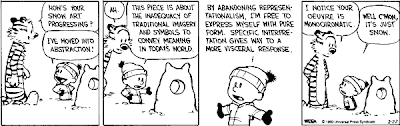
Nothing proves a point like a Calvin & Hobbes comment.
Unfortunatly, however, most of the time when we try to abandon represenation, like the convention of language, we end up with some undescernable blob, somewhat like Calvin's snow structure. Oh well, it was worth a shot.
Going back to language barriers, however, let me relate to you a "fun" story that happened to me today. This year I decided to take a 2nd year Spanish class to follow up the Spanish classes I took last year. However, I am finding that the jump from 1st year to 2nd year to be a bit more of a leap over a gigantic gulf, and I am somewhere in the middle of the gulf. The entire class is carried on in Spanish and some of the time I understand what is going on and most of the time I spend looking down in case the Prof wants to ask me a question that I may not understand, or know how to respond to. (This way I just look really engrossed. "Oooo, Este libro de texto es muy interesante!") This "keeping a low profile" way of learning has been working for me for some time now and so I was feeling pretty good about the class. Today, however, we were talking about the Prado Museum in Madrid, and I rashly said, "I went there!" Perfect, I have now singled myself out as the resident expert about Spain. First the Prof asks me something that I reason out must mean, "What was your experience like?" To this I respond in the most eloquent way I know how and say "Uhhhh.." followed by a dose of "Ummm.." and finally I manage to say something resembling "It was interesting." Wow, now there is a complex sentence for you. The experiences and the answers that followed flowed in much the same stream and I would rather not speak of that painful experience. In the end, the class ended (as classes) do and I continued on my way feeling slightly to very inadequate at Spanish. Thankfully no one else I come in daily contact with speaks Spanish so my embarrasments can be contained to that classroom alone.
Wednesday, September 5, 2007
Beginnings and Perfectionism
I think that the single most destructive force working against me starting or even finishing anything is my perfectionism. Let me relay an example: I have not posted anything on my blog for a couple of weeks. Why? Because my last post was, in my opinion, "good" and I cannot think of anything recently that would match up to the quality of it. See! My need for everything I do to be some sort of feat of excellence prevents me from doing anything much of the time. I suppose I could remedy this by doing a load of things that would be sub-par in some way, but I do not think that would help me. I need to find a way to be okay with some things being very good, some mediocre and some terrible, which I would classify as a mistake and strive not to do again. So I hope this post is sufficiently mediocre for everyone who is reading it.
Moving on to a new subject, lets discuss some thoughts that have come from my first day at university (this fall). My first thoughts were simply, well, back into the swing of things, vaguely indifferent, blah, blah. Then as I went to my first day of classes and began to see all of the work that I will have to do this year in order to simply not fail and etc I got a feeling that can most accuratly be described as "PANIC"! How did I get myself into this stress abyss again? And if I didn't that was enough, I have decided to work while going to school as well. Perfect. So now I just don't know how this whole situation is going to work. Am I going to be able to handle the workload, or will I be crushed by a steamroller called "stress"? Only time will tell I suppose.
Moving on to a new subject, lets discuss some thoughts that have come from my first day at university (this fall). My first thoughts were simply, well, back into the swing of things, vaguely indifferent, blah, blah. Then as I went to my first day of classes and began to see all of the work that I will have to do this year in order to simply not fail and etc I got a feeling that can most accuratly be described as "PANIC"! How did I get myself into this stress abyss again? And if I didn't that was enough, I have decided to work while going to school as well. Perfect. So now I just don't know how this whole situation is going to work. Am I going to be able to handle the workload, or will I be crushed by a steamroller called "stress"? Only time will tell I suppose.
Friday, August 17, 2007
FABULOUS!
I never really thought that I would become one of those people who used the word 'fabulous'. And yet somehow since I became a 'style specialist' at Le Chateau
I have noticed that it has found its way into my vocabulary. Take, for instance, the following exerpts which I have actually spoken:
-At Tim Hortons they hand me my double double and I say "Fabulous!". Then they hand my sandwich and I again respond with "Fabulous!"
- At work, "That dress looks fabulous on you!"
It is not like I am suggesting there is anything wrong with style of speech, or the people who speak this way, I just never thought that I would become one of them.
The big question is then, does this one word change who I am? Have I become a different person, or a person who does life differently just because everything is "Fabulous!"? I don't think that this simple word or the way it changes how I relate to people changes who I essentially am, however it does build on my personality. If it is just a building block on a tall tower (I am fairly tall after all) called "me", is it a brick that I particularily like? I think it is not harmful, provided that I do not draw only on the "Fabulous!" source from here on in.
This discussion points to another important life-concept which has been mulling around in my head for a while. It deals with the building blocks that make up who I am. Every step I take and permission I give myself in a certain direction leads me in that respective direction. To become what we want to become we must build on to ourselves what will lead us in that desired direction. The same goes for the directions we don't want to be carried in. What may seem like a simple exception, could lead me to becoming a person who I definatly don't want to be. So then, we must constantly be on our guard, measuring and testing, to streamline our lives in the way that we want to be going. It can be a tiresome process, but it is what must be done if I want to become a certain way. For instance, if I want to become closer to God (which I do) then I must not do the things that seperate me from him. Yes, I realize this seems simple, but the process of weighing everything I do, is far from simple. Some things are simple. Most things are slightly to really gray. Or a delicate balance. But if I keep on this path towards what God would have me
be I know the outcome will be "Fabulous!"
I have noticed that it has found its way into my vocabulary. Take, for instance, the following exerpts which I have actually spoken:
-At Tim Hortons they hand me my double double and I say "Fabulous!". Then they hand my sandwich and I again respond with "Fabulous!"
- At work, "That dress looks fabulous on you!"
It is not like I am suggesting there is anything wrong with style of speech, or the people who speak this way, I just never thought that I would become one of them.
The big question is then, does this one word change who I am? Have I become a different person, or a person who does life differently just because everything is "Fabulous!"? I don't think that this simple word or the way it changes how I relate to people changes who I essentially am, however it does build on my personality. If it is just a building block on a tall tower (I am fairly tall after all) called "me", is it a brick that I particularily like? I think it is not harmful, provided that I do not draw only on the "Fabulous!" source from here on in.
This discussion points to another important life-concept which has been mulling around in my head for a while. It deals with the building blocks that make up who I am. Every step I take and permission I give myself in a certain direction leads me in that respective direction. To become what we want to become we must build on to ourselves what will lead us in that desired direction. The same goes for the directions we don't want to be carried in. What may seem like a simple exception, could lead me to becoming a person who I definatly don't want to be. So then, we must constantly be on our guard, measuring and testing, to streamline our lives in the way that we want to be going. It can be a tiresome process, but it is what must be done if I want to become a certain way. For instance, if I want to become closer to God (which I do) then I must not do the things that seperate me from him. Yes, I realize this seems simple, but the process of weighing everything I do, is far from simple. Some things are simple. Most things are slightly to really gray. Or a delicate balance. But if I keep on this path towards what God would have me
be I know the outcome will be "Fabulous!"
Subscribe to:
Posts (Atom)
